Explore notes
For continuously differentiable u , v u,v u , v [ a , b ] [a,b] [ a , b ] ( u v ) ′ = u ′ v + u v ′ (uv)'=u'v+uv' ( uv ) ′ = u ′ v + u v ′
∫ a b u ( x ) v ′ ( x ) d x = [ u ( x ) v ( x ) ] a b − ∫ a b v ( x ) u ′ ( x ) d x . \int_a^b u(x)v'(x)\,dx=[u(x)v(x)]_a^b-\int_a^b v(x)u'(x)\,dx. ∫ a b u ( x ) v ′ ( x ) d x = [ u ( x ) v ( x ) ] a b − ∫ a b v ( x ) u ′ ( x ) d x . Choose u u u d v dv d v x x x ln x ⋅ 1 \ln x\cdot1 ln x ⋅ 1
For the quadratic substitutions below take a , b > 0 a,b>0 a , b > 0 − π / 2 < θ < π / 2 -\pi/2<\theta<\pi/2 − π /2 < θ < π /2 x > a / b x>a/b x > a / b 0 < θ < π / 2 0<\theta<\pi/2 0 < θ < π /2 x x x 0 < ∣ x ∣ < 2 / 3 0<|x|<2/3 0 < ∣ x ∣ < 2/3 θ = arcsin ( 3 x / 2 ) \theta=\arcsin(3x/2) θ = arcsin ( 3 x /2 ) cos θ > 0 \cos\theta>0 cos θ > 0 x x x cot θ = cos θ / sin θ \cot\theta=\cos\theta/\sin\theta cot θ = cos θ / sin θ
For partial fractions, divide polynomials first if the numerator degree is not smaller. Factor over the reals; quadratic factors in the table must be irreducible (b 2 − 4 a c < 0 b^2-4ac<0 b 2 − 4 a c < 0 x < 1 x<1 x < 1 x > 1 x>1 x > 1
Integration by Parts
Integration by parts is a technique based on the product rule for differentiation. The formula is:
∫ u d v = u v − ∫ v d u \int u dv = uv - \int v du ∫ u d v = uv − ∫ v d u The choice of u u u d v dv d v u u u d v dv d v d u du d u v v v
Example I
∫ x e − x d x \int x e^{-x} \, dx ∫ x e − x d x Let u = x u = x u = x d u = d x du = dx d u = d x d v = e − x d x dv = e^{-x} dx d v = e − x d x v = − e − x v = -e^{-x} v = − e − x
By the integration by parts formula ∫ u d v = u v − ∫ v d u \int u \, dv = uv - \int v \, du ∫ u d v = uv − ∫ v d u
∫ x e − x d x = u v − ∫ v d u \int x e^{-x} \, dx = uv - \int v \, du ∫ x e − x d x = uv − ∫ v d u ∫ x e − x d x = − x e − x − ∫ − e − x d x \int x e^{-x} \, dx = -x e^{-x} - \int -e^{-x} \, dx ∫ x e − x d x = − x e − x − ∫ − e − x d x Since ∫ − e − x d x = e − x \int -e^{-x}\,dx=e^{-x} ∫ − e − x d x = e − x
∫ x e − x d x = − x e − x − e − x + C = − ( x + 1 ) e − x + C \int x e^{-x} \, dx = -x e^{-x} - e^{-x} + C = -(x+1)e^{-x}+C ∫ x e − x d x = − x e − x − e − x + C = − ( x + 1 ) e − x + C Where C C C
Example II
∫ 3 5 ln ( x ) d x \int_{3}^{5} \ln(x) \, dx ∫ 3 5 ln ( x ) d x Let u = ln ( x ) u = \ln(x) u = ln ( x ) d u = 1 x d x du = \frac{1}{x}dx d u = x 1 d x d v = d x dv = dx d v = d x v = x v = x v = x
Using the integration by parts formula ∫ a b u d v = u v ∣ a b − ∫ a b v d u \int_{a}^{b} u \, dv = uv \bigg|_{a}^{b} - \int_{a}^{b} v \, du ∫ a b u d v = uv a b − ∫ a b v d u
∫ 3 5 ln ( x ) d x = x ln ( x ) ∣ 3 5 − ∫ 3 5 x 1 x d x \int_{3}^{5} \ln(x) \, dx = x\ln(x) \bigg|_{3}^{5} - \int_{3}^{5} x \, \frac{1}{x} \, dx ∫ 3 5 ln ( x ) d x = x ln ( x ) 3 5 − ∫ 3 5 x x 1 d x Simplifying the integral ∫ 3 5 x 1 x d x \int_{3}^{5} x \, \frac{1}{x} \, dx ∫ 3 5 x x 1 d x ∫ 3 5 d x \int_{3}^{5} dx ∫ 3 5 d x
∫ 3 5 ln ( x ) d x = x ln ( x ) ∣ 3 5 − ∫ 3 5 d x \int_{3}^{5} \ln(x) \, dx = x\ln(x) \bigg|_{3}^{5} - \int_{3}^{5} dx ∫ 3 5 ln ( x ) d x = x ln ( x ) 3 5 − ∫ 3 5 d x ∫ 3 5 ln ( x ) d x = x ln ( x ) ∣ 3 5 − x ∣ 3 5 \int_{3}^{5} \ln(x) \, dx = x\ln(x) \bigg|_{3}^{5} - x \bigg|_{3}^{5} ∫ 3 5 ln ( x ) d x = x ln ( x ) 3 5 − x 3 5 Subtracting 5 − 3 5 - 3 5 − 3 5 ln ( 5 ) − 3 ln ( 3 ) 5\ln(5) - 3\ln(3) 5 ln ( 5 ) − 3 ln ( 3 )
∫ 3 5 ln ( x ) d x = 5 ln ( 5 ) − 3 ln ( 3 ) − ( 5 − 3 ) \int_{3}^{5} \ln(x) \, dx = 5\ln(5) - 3\ln(3) - (5 - 3) ∫ 3 5 ln ( x ) d x = 5 ln ( 5 ) − 3 ln ( 3 ) − ( 5 − 3 ) ∫ 3 5 ln ( x ) d x = 5 ln ( 5 ) − 3 ln ( 3 ) − 2 \int_{3}^{5} \ln(x) \, dx = 5\ln(5) - 3\ln(3) - 2 ∫ 3 5 ln ( x ) d x = 5 ln ( 5 ) − 3 ln ( 3 ) − 2 Trigonometric Substitutions in Integration
Case 1: a 2 − b 2 x 2 \sqrt{a^2 - b^2x^2} a 2 − b 2 x 2
Substitution: x = a b sin ( θ ) x = \frac{a}{b} \sin(\theta) x = b a sin ( θ ) Identity: cos 2 ( θ ) = 1 − sin 2 ( θ ) \cos^2(\theta) = 1 - \sin^2(\theta) cos 2 ( θ ) = 1 − sin 2 ( θ )
Case 2: b 2 x 2 − a 2 \sqrt{b^2x^2 - a^2} b 2 x 2 − a 2
Substitution: x = a b sec ( θ ) x = \frac{a}{b} \sec(\theta) x = b a sec ( θ ) Identity: tan 2 ( θ ) = sec 2 ( θ ) − 1 \tan^2(\theta) = \sec^2(\theta) - 1 tan 2 ( θ ) = sec 2 ( θ ) − 1
Case 3: a 2 + b 2 x 2 \sqrt{a^2 + b^2x^2} a 2 + b 2 x 2
Substitution: x = a b tan ( θ ) x = \frac{a}{b} \tan(\theta) x = b a tan ( θ ) Identity: sec 2 ( θ ) = 1 + tan 2 ( θ ) \sec^2(\theta) = 1 + \tan^2(\theta) sec 2 ( θ ) = 1 + tan 2 ( θ )
Example
∫ 16 x 2 4 − 9 x 2 d x \int \frac{16}{x^2 \sqrt{4-9x^2}} \, dx ∫ x 2 4 − 9 x 2 16 d x Let x = 2 3 sin ( θ ) x = \frac{2}{3} \sin(\theta) x = 3 2 sin ( θ ) d x = 2 3 cos ( θ ) d θ dx = \frac{2}{3}\cos(\theta)d\theta d x = 3 2 cos ( θ ) d θ
4 − 9 x 2 = 4 − 4 sin 2 ( θ ) = 4 cos 2 ( θ ) = 2 ∣ cos ( θ ) ∣ \sqrt{4-9x^2}=\sqrt{4-4\sin^2(\theta)}=\sqrt{4\cos^2(\theta)}= 2 \mid \cos(\theta) \mid 4 − 9 x 2 = 4 − 4 sin 2 ( θ ) = 4 cos 2 ( θ ) = 2 ∣ cos ( θ ) ∣ In this case we have 4 − 9 x 2 = 2 cos ( θ ) \sqrt{4-9x^2} = 2\cos(\theta) 4 − 9 x 2 = 2 cos ( θ )
∫ 16 x 2 4 − 9 x 2 d x = ∫ 16 ( 2 3 sin ( θ ) ) 2 ⋅ 2 cos ( θ ) ⋅ 2 3 cos ( θ ) d θ = ∫ 12 sin 2 ( θ ) d θ \int \frac{16}{x^2 \sqrt{4-9x^2}} \, dx = \int \frac{16}{\left(\frac{2}{3}\sin(\theta)\right)^2 \cdot 2\cos(\theta)} \cdot \frac{2}{3}\cos(\theta) \, d\theta = \int \frac{12}{\sin^2(\theta)} \, d\theta ∫ x 2 4 − 9 x 2 16 d x = ∫ ( 3 2 sin ( θ ) ) 2 ⋅ 2 cos ( θ ) 16 ⋅ 3 2 cos ( θ ) d θ = ∫ sin 2 ( θ ) 12 d θ ∫ 16 ( 2 3 sin ( θ ) ) 2 ⋅ 2 cos ( θ ) ⋅ 2 3 cos ( θ ) d θ = ∫ 12 csc 2 ( θ ) d θ \int \frac{16}{\left(\frac{2}{3}\sin(\theta)\right)^2 \cdot 2\cos(\theta)} \cdot \frac{2}{3}\cos(\theta) \, d\theta = \int 12 \csc^2(\theta) \, d\theta ∫ ( 3 2 sin ( θ ) ) 2 ⋅ 2 cos ( θ ) 16 ⋅ 3 2 cos ( θ ) d θ = ∫ 12 csc 2 ( θ ) d θ This simplification uses the identity sin 2 ( θ ) + cos 2 ( θ ) = 1 \sin^2(\theta) + \cos^2(\theta) = 1 sin 2 ( θ ) + cos 2 ( θ ) = 1 csc ( θ ) = 1 sin ( θ ) \csc(\theta) = \frac{1}{\sin(\theta)} csc ( θ ) = s i n ( θ ) 1
The antiderivative of csc 2 ( θ ) \csc^2(\theta) csc 2 ( θ ) − cot ( θ ) - \cot(\theta) − cot ( θ )
∫ 12 csc 2 ( θ ) d θ = − 12 cot ( θ ) + C \int 12 \csc^2(\theta) \, d\theta = -12 \cot(\theta) + C ∫ 12 csc 2 ( θ ) d θ = − 12 cot ( θ ) + C Using Right Triangle Trigonometry
To convert back to x x x sin ( θ ) = 3 x 2 \sin(\theta) = \frac{3x}{2} sin ( θ ) = 2 3 x
The triangle formed by the substitution suggests that:
cot ( θ ) = 4 − 9 x 2 3 x \cot(\theta) = \frac{\sqrt{4 - 9x^2}}{3x} cot ( θ ) = 3 x 4 − 9 x 2 Final Integral in terms of X
Substituting cot ( θ ) \cot(\theta) cot ( θ )
− 12 cot ( θ ) + C = − 4 4 − 9 x 2 1 x + C -12 \cot(\theta) + C = -4\sqrt{4 - 9x^2} \frac{1}{x} + C − 12 cot ( θ ) + C = − 4 4 − 9 x 2 x 1 + C Thus, the final antiderivative in terms of x x x
∫ 16 x 2 4 − 9 x 2 d x = − 4 4 − 9 x 2 x + C \int \frac{16}{x^2 \sqrt{4 - 9x^2}} \, dx = -4 \frac{\sqrt{4 - 9x^2}}{x} + C ∫ x 2 4 − 9 x 2 16 d x = − 4 x 4 − 9 x 2 + C Open full-size image Match the labels to the worked substitution: replace the figure’s a by 2 and its x by 3x. For 0 < x < 2/3, the adjacent side is √(4 − 9x²), so cot θ is adjacent divided by opposite. For negative x, use the signed trigonometric identity already stated above rather than negative side lengths. Access for free at OpenStax.
Partial Fraction Decomposition for Integration
Concept
Partial fractions is a technique used to simplify the integration of rational expressions, P ( x ) Q ( x ) \frac{P(x)}{Q(x)} Q ( x ) P ( x ) P ( x ) P(x) P ( x ) Q ( x ) Q(x) Q ( x )
Steps for Decomposition
Factor the denominator Q ( x ) Q(x) Q ( x )
Write down a partial fraction for each factor in Q ( x ) Q(x) Q ( x )
Solve for the constants by clearing the denominators and equating coefficients for corresponding powers of x x x
Table for Decomposition
Factor of Q ( x ) Q(x) Q ( x ) Term in Partial Fraction Decomposition (P.F.D) a x + b ax + b a x + b A a x + b \frac{A}{ax + b} a x + b A a x 2 + b x + c ax^2 + bx + c a x 2 + b x + c A x + B a x 2 + b x + c \frac{Ax + B}{ax^2 + bx + c} a x 2 + b x + c A x + B ( a x + b ) k (ax + b)^k ( a x + b ) k A 1 a x + b + A 2 ( a x + b ) 2 + ⋯ + A k ( a x + b ) k \frac{A_1}{ax + b} + \frac{A_2}{(ax + b)^2} + \cdots + \frac{A_k}{(ax + b)^k} a x + b A 1 + ( a x + b ) 2 A 2 + ⋯ + ( a x + b ) k A k ( a x 2 + b x + c ) k (ax^2 + bx + c)^k ( a x 2 + b x + c ) k A 1 x + B 1 a x 2 + b x + c + ⋯ + A k x + B k ( a x 2 + b x + c ) k \frac{A_1x + B_1}{ax^2 + bx + c} + \cdots + \frac{A_kx + B_k}{(ax^2 + bx + c)^k} a x 2 + b x + c A 1 x + B 1 + ⋯ + ( a x 2 + b x + c ) k A k x + B k
Example of Integration Using Partial Fraction
∫ 7 x 2 + 13 x ( x − 1 ) ( x 2 + 4 ) d x \int \frac{7x^2 + 13x}{(x - 1)(x^2 + 4)} \, dx ∫ ( x − 1 ) ( x 2 + 4 ) 7 x 2 + 13 x d x Partial Fraction Decomposition
To decompose the function, assume it can be written as the sum of fractions:
7 x 2 + 13 x ( x − 1 ) ( x 2 + 4 ) = A x − 1 + B x + C x 2 + 4 \frac{7x^2 + 13x}{(x - 1)(x^2 + 4)} = \frac{A}{x - 1} + \frac{Bx + C}{x^2 + 4} ( x − 1 ) ( x 2 + 4 ) 7 x 2 + 13 x = x − 1 A + x 2 + 4 B x + C Where A A A B B B C C C
Finding Constants
Multiply both sides by the common denominator ( x − 1 ) ( x 2 + 4 ) (x - 1)(x^2 + 4) ( x − 1 ) ( x 2 + 4 )
7 x 2 + 13 x = A ( x 2 + 4 ) + ( B x + C ) ( x − 1 ) 7x^2 + 13x = A(x^2 + 4) + (Bx + C)(x - 1) 7 x 2 + 13 x = A ( x 2 + 4 ) + ( B x + C ) ( x − 1 ) Expanding the right side and collecting like terms gives:
7 x 2 + 13 x = ( A + B ) x 2 + ( C − B ) x + 4 A − C 7x^2 + 13x = (A + B)x^2 + (C - B)x + 4A - C 7 x 2 + 13 x = ( A + B ) x 2 + ( C − B ) x + 4 A − C Setting Coefficients Equal
Match the coefficients of corresponding powers of x x x
x 2 : A + B = 7 x : C − B = 13 Constant : 4 A − C = 0 \begin{align*}
x^2: & \quad A + B = 7 \\
x: & \quad C - B = 13 \\
\text{Constant}: & \quad 4A - C = 0
\end{align*} x 2 : x : Constant : A + B = 7 C − B = 13 4 A − C = 0 Solving the System of Equations
Solve this system of linear equations to find the values of A A A B B B C C C
A = 4 B = 3 C = 16 \begin{align*}
A & = 4 \\
B & = 3 \\
C & = 16
\end{align*} A B C = 4 = 3 = 16 Rewriting the Integral
Substitute the values of A A A B B B C C C
∫ 4 x − 1 + 3 x + 16 x 2 + 4 d x \int \frac{4}{x - 1} + \frac{3x + 16}{x^2 + 4} \, dx ∫ x − 1 4 + x 2 + 4 3 x + 16 d x Integrating Each Term
For 4 x − 1 \frac{4}{x - 1} x − 1 4 4 ln ∣ x − 1 ∣ 4 \ln|x - 1| 4 ln ∣ x − 1∣
For 3 x x 2 + 4 \frac{3x}{x^2 + 4} x 2 + 4 3 x u = x 2 + 4 u = x^2 + 4 u = x 2 + 4 3 2 ln ∣ x 2 + 4 ∣ \frac{3}{2} \ln|x^2 + 4| 2 3 ln ∣ x 2 + 4∣
For 16 x 2 + 4 \frac{16}{x^2 + 4} x 2 + 4 16 8 tan − 1 ( x 2 ) 8\tan^{-1}\left(\frac{x}{2}\right) 8 tan − 1 ( 2 x ) d d x [ tan − 1 ( x 2 ) ] = 2 x 2 + 4 \frac{d}{dx}\left[\tan^{-1}\left(\frac{x}{2}\right)\right] = \frac{2}{x^2 + 4} d x d [ tan − 1 ( 2 x ) ] = x 2 + 4 2
Final Answer
Combine all antiderivatives and add the constant of integration to get the final solution:
∫ 7 x 2 + 13 x ( x − 1 ) ( x 2 + 4 ) d x = 4 ln ∣ x − 1 ∣ + 3 2 ln ∣ x 2 + 4 ∣ + 8 tan − 1 ( x 2 ) + C \int \frac{7x^2 + 13x}{(x - 1)(x^2 + 4)} \, dx = 4 \ln|x - 1| + \frac{3}{2} \ln|x^2 + 4| + 8\tan^{-1}\left(\frac{x}{2}\right) + C ∫ ( x − 1 ) ( x 2 + 4 ) 7 x 2 + 13 x d x = 4 ln ∣ x − 1∣ + 2 3 ln ∣ x 2 + 4∣ + 8 tan − 1 ( 2 x ) + C My reading · Opened notes are remembered in this browser. 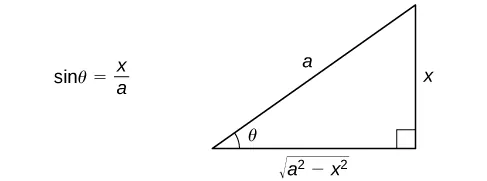 Open full-size image