Integral Definitions
This page concerns real, one-variable Riemann integration. A definite integral is a number; an indefinite integral is a family of functions. Both use integration notation, but answer different questions.
Integral Calculus
Definite Integral
-
Concept: A definite integral accumulates height times width over an interval
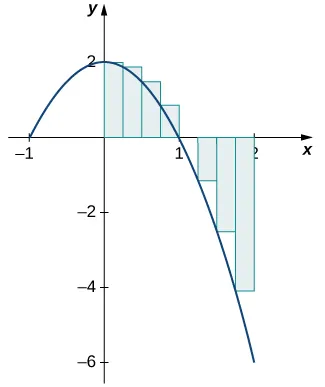
[a, b]. Divide the interval into small pieces, multiply a sampled function value by each piece’s width, and add the results. If these sums approach the same value as the largest piece shrinks to zero, independently of the sample points, that value is the integral. Contributions below the horizontal axis count negatively. -
Mathematical Definition:
where is the width of the subintervals, is a sample point in each interval, and the function is continuous on
[a, b].
 Open full-size image
This example uses f(x) = 2 − 2x² on [0, 2]. Each rectangle contributes its signed height times its width: positive above the axis, negative below. Follow the signs before adding the areas; the integral measures the net accumulation.
Anti-Derivative
- Concept: An anti-derivative of a function is a function whose derivative is .
- Relationship: If , then is an anti-derivative of .
Indefinite Integral
-
Concept: The indefinite integral represents a family of functions that are anti-derivatives of .
-
General Form:
where is the constant of integration, encapsulating all possible anti-derivatives of .
What the sum measures
For the equal partition, and , with . Each term is height times width, not just a function value. The limit must be independent of the sample points. In the general Riemann definition, unequal widths are allowed and the largest width tends to zero. Continuity is sufficient, not necessary: a bounded step function with finitely many jumps is also integrable.
For on , right endpoints give
This limit defines the integral without first finding an antiderivative. In contrast, follows by differentiation. On an interval, any two antiderivatives differ by a constant, because their difference has derivative zero. On disconnected domains, such as for , the constants can differ on each component.
The integral counts area below the axis negatively: , although the geometric area is . Integrating velocity gives displacement; integrating its absolute value gives distance. Integral units are the units of multiplied by those of .