Continuity
A function is continuous at when
- is defined;
- exists;
- .
Thus continuity joins two kinds of information: the function's nearby behavior and its assigned value at the point.
One-Sided and Interval Continuity
At an endpoint, only the side contained in the domain is relevant. A function is continuous on when it is continuous on , right-continuous at , and left-continuous at :
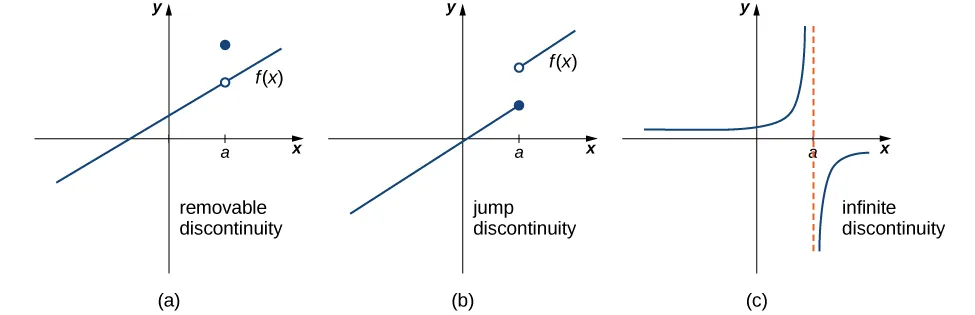
Typical discontinuities include a removable hole, a jump between unequal one-sided limits, and unbounded behavior near a vertical asymptote.
 Open full-size image
Compare the open circle, the filled point, and the values approached from each side. In (a), changing the single assigned value can restore continuity. In (b), the two one-sided limits disagree; in (c), the values become unbounded. Neither can be repaired by changing just f(a). Access for free at OpenStax.
Functions Built from Continuous Functions
Polynomials are continuous on . Rational functions are continuous where their denominators are nonzero. Exponential, logarithmic, trigonometric, and root functions are continuous on their respective domains.
Sums, products, and valid quotients of continuous functions remain continuous. If is continuous at and is continuous at , then
is continuous at . This justifies moving the limit through under those continuity hypotheses:
Intermediate Value Theorem
If is continuous on and lies between and , then there is at least one such that .
The theorem guarantees existence, not uniqueness or a formula for . In particular, if and have opposite signs, at least one root lies in .
Repairing a hole and locating a root
Let for and . Near , cancellation gives , so the limit is . Exactly the choice makes continuous at ; changing one value can repair a hole but cannot repair a jump.
For , continuity and , guarantee a root in . Bisection retains the half-interval whose endpoint values have opposite signs; since , the first retained interval is . After halvings its width is , so the midpoint is within of a root. Continuity is essential: has opposite signs at and but no zero, because it is not continuous on .