Multivariable Functions and Partial Derivatives
Overview
Calculus extends its inquiry into functions of multiple variables, shifting from the study of single-variable functions and their derivatives to exploring the terrain of multivariable functions. This progression is essential for delving into domains such as optimization and machine learning, where functions often depend on numerous variables.
Tangents: From Lines to Planes
Single Variable Context
Consider a univariate function, . Its derivative, , represents the slope of the tangent line at any given point on the curve. For instance, at , the function value is and the tangent-line slope is .
Multivariable Context
In contrast, for a bivariate function , the concept of tangency expands from a line to a plane. To visualize this function and its tangent structures, one must employ a 3-dimensional plot, where the and axes define the plane and the axis represents the function value, .
Deriving the Tangent Plane
The construction of a tangent plane at a given point on the surface defined by involves analyzing the function's behavior along two distinct paths that intersect at the point of interest.
Procedure
Fixing
- By fixing (e.g., ), the function reduces to a single-variable context along the -axis, resulting in a slice .
- The derivative of this slice with respect to , , gives the slope of the tangent line in the direction of the -axis.
Fixing
- Similarly, by fixing (e.g., ), and considering a slice along the -axis, .
- The derivative of this slice with respect to , , provides the slope of the tangent line in the direction of the -axis.
Tangent Plane Synthesis
When the function is differentiable at the point, its tangent plane is spanned by these two intersecting tangent lines. Partial derivatives alone do not guarantee differentiability; see the example below.
Partial Derivatives
Conceptual Overview
Consider a function representing a surface in three-dimensional space. If we slice this surface with a plane (holding fixed) or (holding fixed), we obtain a curve on the surface. The slope of the tangent to this curve at any point represents a partial derivative of the function at that point, depending on the direction of the slice.
Visualization Through Slicing
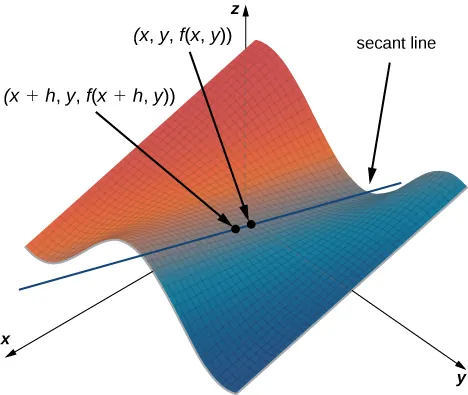
- Slicing Parallel to the -axis: Fixing a value of and treating it as a constant transforms into a function of a single variable , represented by a curve on the surface. The slope of the tangent to this curve is the partial derivative of with respect to , denoted as or .
- Slicing Parallel to the -axis: Similarly, fixing and treating it as a constant transforms into a function of alone. The slope of the tangent to this curve is the partial derivative of with respect to , denoted as or .
 Open full-size image
Both labeled points keep y fixed. Divide their height difference by h to get the secant slope; as h approaches zero, its limit is the partial derivative with respect to x, when that limit exists. The generic surface illustrates this construction rather than the quadratic example above. Access for free at OpenStax.
Calculating Partial Derivatives
Example 1: Function
- Partial Derivative with Respect to : Treating as a constant, the partial derivative is obtained by differentiating with respect to , yielding .
- Partial Derivative with Respect to : Treating as a constant, the partial derivative is .
General Method
- Fix Other Variables: Treat all variables other than the one with respect to which differentiation is performed as constants.
- Differentiate: Apply normal differentiation rules to the function with respect to the variable of interest.
Example 2: Function
- Partial Derivative with Respect to : Treating as constant, differentiate with respect to , leading to .
- Partial Derivative with Respect to : Treating as constant, differentiate with respect to , resulting in .
When the tangent plane is a valid approximation
At an interior point , the partial derivative is a limit with the other input fixed:
A tangent plane approximates changes in all directions only when is differentiable there. This means
Continuous partial derivatives in a neighborhood are a sufficient condition. The plane for at is therefore . At it predicts , versus the exact ; the missing quadratic terms contribute .
Existence of partial derivatives alone is insufficient. Define away from the origin and . Both partial derivatives at the origin are zero, but along , . The function is not even continuous there, so its coordinate slices do not justify a tangent-plane approximation.