Derivatives and Critical Points Analysis
The sign tests below concern intervals where the stated derivatives exist, not isolated sample points. For the second-derivative test, assume is interior and is twice continuously differentiable near . The curve-analysis reference explains the distinction between extrema and inflection points.
Derivatives
- First Derivative : Reflects the slope or rate of change of at any point .
- Second Derivative : Measures how the slope changes; its sign determines concavity on intervals where it exists.
- Higher Order Derivatives: The -th derivative represents the rate of change of the -th derivative.
Critical Points
- A number in the domain of is a critical number if or does not exist; the corresponding is a critical point on the graph.
- Second-derivative test: If and , then has a local minimum at . If , it has a local maximum. When , the test is inconclusive.
- Inflection Point: A point where the graph's concavity actually changes. The condition alone is not enough.
Newton's Method
-
A tangent-based iteration for approximating roots; convergence is not automatic.
-
Given by the formula:
Implicit Differentiation
- Used for functions that are not explicitly solved for . The derivative is found using the chain rule and other differentiation rules.
Increasing and Decreasing Intervals
- Increasing: implies that is increasing on that interval.
- Decreasing: implies that is decreasing on that interval.
Concavity and Points of Inflection
- Concave Up: If for all in an interval, is concave up on that interval.
- Concave Down: If for all in an interval, is concave down on that interval.
- Inflection Point: If is continuous at and has opposite signs on the intervals immediately to either side, then is an inflection point.
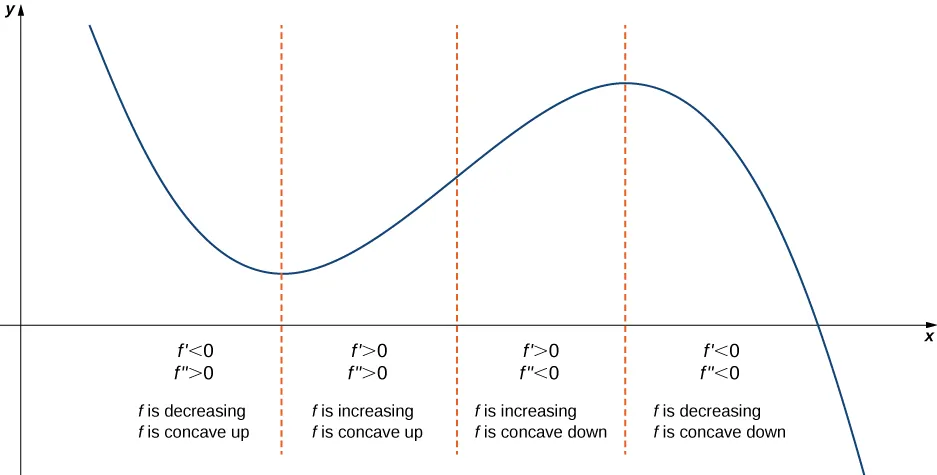 Open full-size image
Read the two signs separately: f′ tells whether the curve rises or falls, while f″ tells whether its slope increases or decreases. At the middle dashed line, concavity changes while the curve continues rising. This schematic illustrates the sign rules; the polynomial example below has its own graph. Access for free at OpenStax.
Classifying candidates: a complete example
At a differentiable interior local extremum, (Fermat's theorem). The converse fails: has derivative zero at but is increasing through it. For a continuous function, a first derivative changing from positive to negative gives a local maximum; negative to positive gives a local minimum. If the sign does not change, this test gives neither. The function must be differentiable on the adjacent intervals.
Take on . Then
The interior critical numbers are . The derivative is positive on , negative on , and positive on . Hence is a local maximum and a local minimum. For absolute extrema on the closed interval, compare endpoints too: and . The minimum occurs at and ; the maximum occurs at and . Continuity on a closed bounded interval guarantees that absolute extrema are attained; candidate testing still requires finding all candidates.
The second derivative changes sign at , where the graph is continuous, so is an inflection point. Compare : its second derivative is zero at without a concavity change. For , concavity changes at although the second derivative does not exist there. For , the second derivative changes sign across zero but there is no graph point there, so no inflection point. Also, is not itself geometric curvature; for a twice differentiable graph, unsigned curvature is .
Implicit calculation and Newton iteration
For , along a differentiable branch , differentiation gives . Thus when ; at the slope is . At this division is invalid and the circle has vertical tangents. More generally, by the implicit function theorem, for a continuously differentiable equation , the condition at a solution guarantees a local differentiable branch, with .
Newton's method sets the tangent-line prediction to zero: . This gives the formula above only if . For , start at :
For a twice continuously differentiable function near a simple root (one with nonzero derivative), starting sufficiently close gives local convergence. A distant initial guess need not work: for , starting at cycles . In a computation, set an iteration limit, reject undefined values and zero or dangerously small derivatives, and check both the step size and residual . A small step alone does not certify a root.