Fibonacci as a Dynamic Programming Example
The Fibonacci recurrence is
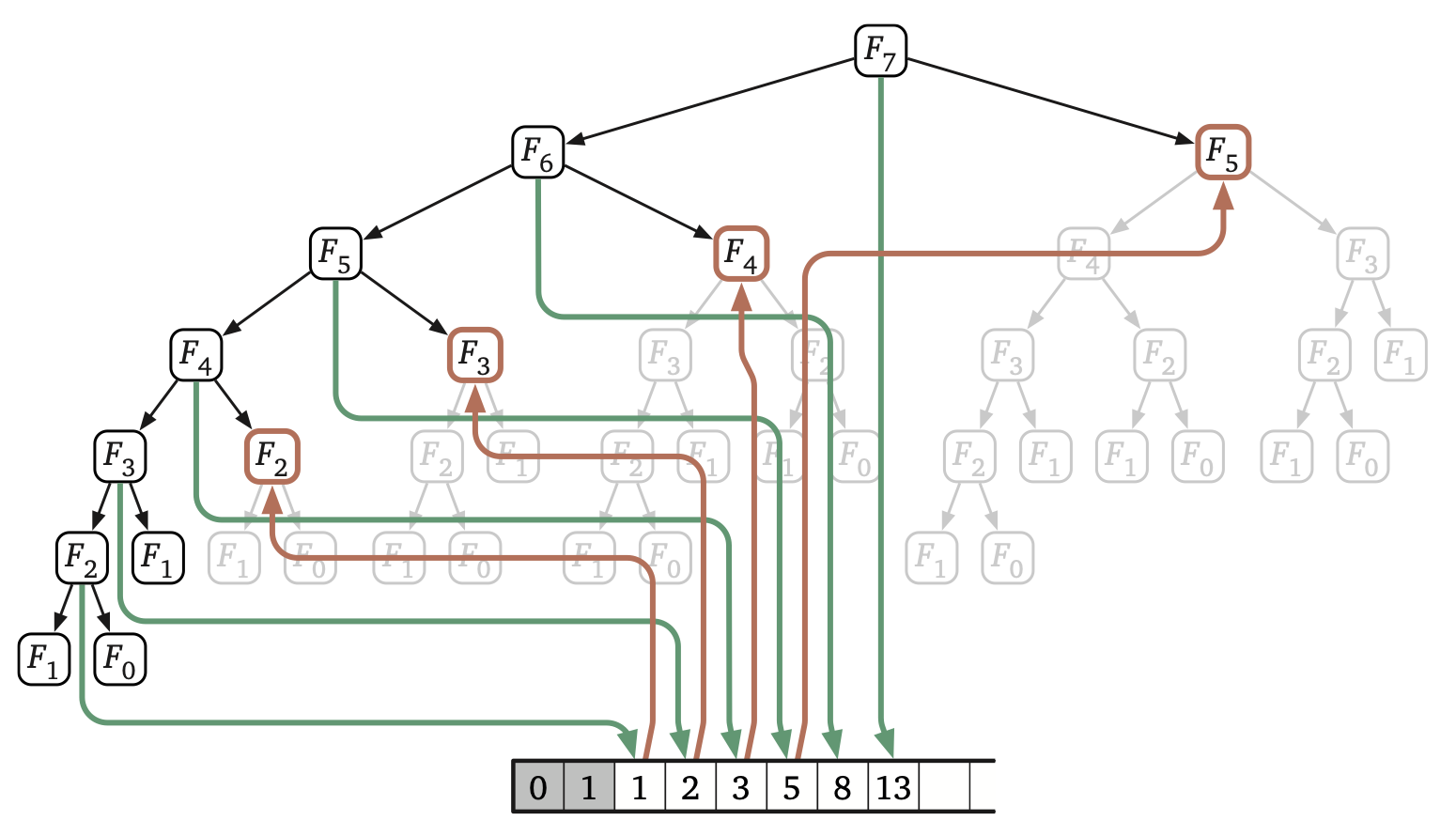
Naive recursion expands the same subproblems repeatedly and takes exponential time. Memoization evaluates each of the distinct states once instead of recomputing them; bottom-up evaluation makes their dependency order explicit.
 Open full-size image
Green downward arrows write newly computed values into the cache; red upward arrows reuse them. When the right-hand call needs F5, its value is already stored, so the grey subtree is never expanded. The figure computes F7 = 13 using memoized recursion. The loop below goes one step further: it evaluates in order and keeps only the two values needed for the next addition.
def fibonacci(n: int) -> int:
    if n < 0:
        raise ValueError("n must be non-negative")
    previous, current = 0, 1
    for _ in range(n):
        previous, current = current, previous + current
    return previous
State compression
To compute , a table would retain every value from through . The transition reads only the previous two, so two variables are sufficient:
- time: arithmetic operations;
- auxiliary state: integer variables;
- integer bit size still grows with , so bit-complexity is not constant per addition for very large indices.
What the example teaches
Fibonacci is useful for recognizing overlapping subproblems and safe memory compression, but it is not a representative optimization problem. Faster doubling or matrix methods compute with recurrence depth by using additional algebraic structure.
Avoid a mutable default dictionary in memoized Python examples; cache ownership and lifetime should be explicit.
Trace and integer cost
Before iteration k, (previous, current) equals (F_k, F_(k+1)). Simultaneous assignment preserves this invariant; after n iterations previous is the answer. For n=5 the successive pairs are (0,1), (1,1), (1,2), (2,3), (3,5), (5,8), giving 5. For n=0 the loop does nothing and returns 0; negative n is rejected. The input must be an integer.
The two variables hold a constant number of integers, not a constant number of fixed-size machine words for arbitrary n. Fibonacci numbers have Θ(n) bits. With ordinary linear-time integer addition, this loop therefore takes O(n²) bit operations and O(n) auxiliary bits.
assert fibonacci(0) == 0
assert fibonacci(5) == 5
Try a small index such as 6 in the USF Fibonacci workbench, comparing recursive, memoized, and table modes. Count distinct subproblem indices separately from total calls; this reveals what caching saves before the two-variable loop removes the table. The demo uses base values 1 and 1, so its numeric sequence is shifted relative to this page’s 0 and 1; compare the reuse pattern.