How to Learn with AI
AI can explain a missing prerequisite, produce another example, and check an answer within seconds. That is useful until its smooth explanations start replacing the learner's own recall and problem solving.
The point is not to remove effort. It is to spend the effort on the subject instead of hunting for the next exercise or reconciling several notations.
Start with a specific gap
"Teach me linear algebra" gives the tutor too much room to talk. Pick a target such as eigendecomposition and ask for a few short questions on the likely prerequisites.
The answers show more than asking whether someone knows matrices, determinants, and bases. Once the first missing dependency appears, stop the diagnosis and work on it. A long placement test can become another way to avoid the subject.
Ask for one step, then try the next one
Request an explanation at the level of the gap. A useful response has one worked example and a nearby example left unfinished.
Check important definitions and equations against a textbook, paper, or official reference. Fluency is not evidence. The model can translate several sources into one notation, but it cannot replace those sources.
Close the explanation and recall it
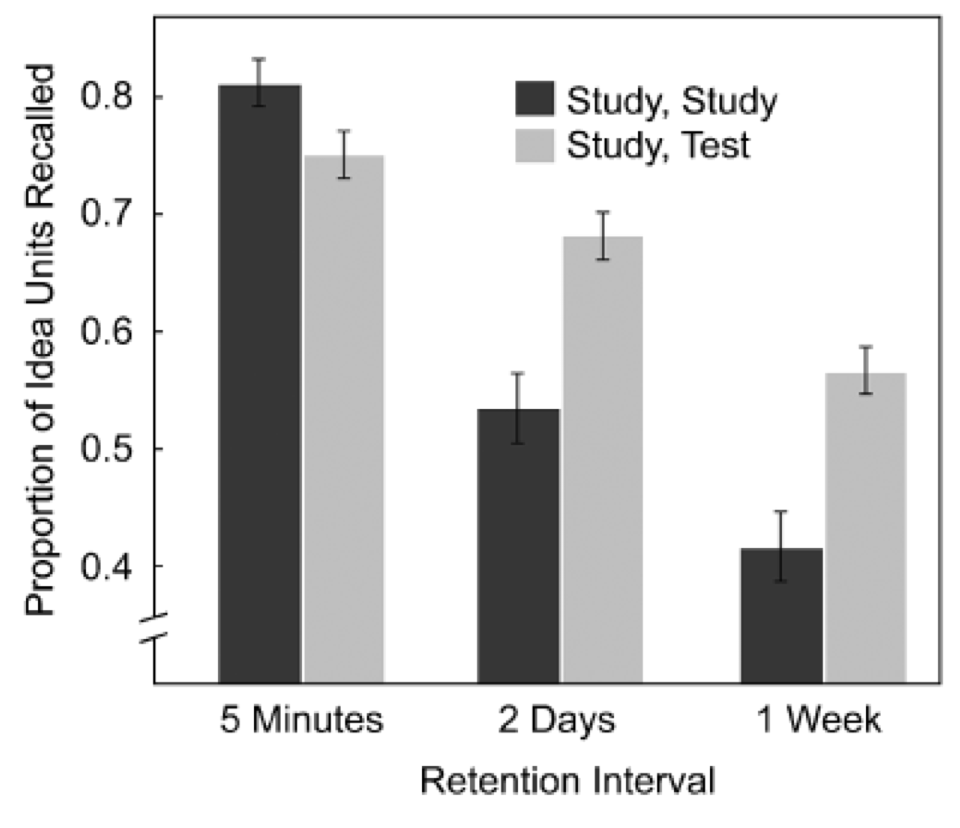
After reading, hide the answer and reconstruct the idea from memory. Work on test-enhanced learning by Roediger and Karpicke gives a reason to prefer retrieval over another reread.
Useful checks include:
- explain the idea in ordinary language;
- derive the main step without looking;
- solve a nearby problem with different assumptions;
- explain why a tempting wrong answer fails.
A correct paraphrase is not enough when the goal is a proof, calculation, or program.
 Open full-size image
Compare the dark restudy bars with the light recall-test bars. In this passage-learning experiment, rereading helped more after five minutes; recalling without feedback helped more after two days and one week. The vertical axis measures remembered idea units and has a break near its base; error bars show standard errors. This supports checking delayed recall, but the experiment did not test AI tutoring.
Save the next move, not the whole chat
A small learning record can keep the current target, confirmed prerequisites, one open misconception, and the next practice problem.
current_target: eigendecomposition
confirmed:
  - matrix multiplication
  - basis and linear independence
open_gap: geometric meaning of an eigenspace
next_check: explain why Av stays on the line through v, and what the sign of λ changes
The learner's work and the next question are usually more useful than a transcript of the tutor's monologue.
Watch for three failure modes
A clear explanation can feel like understanding before the learner has produced anything. Rozenblit and Keil found that people often overestimate how well they understand a mechanism until they try to explain it in detail. AI makes that mistake easier because another polished paragraph is always available.
The model can also do all the productive work. If it writes every proof, derivation, and program, the session may produce attractive notes without much learning. Ask for a hint, counterexample, or next question before requesting a complete solution.
Finally, a wrong answer can become the foundation for everything that follows. Tie specialized claims to sources and check important equations independently. When sources disagree, keep the disagreement visible instead of asking the model to blend them into one confident answer.
Keep the division of labor simple
Let AI generate questions, switch notation, retrieve sources, and give quick feedback. Keep recall, derivation, judgment, and the final explanation with the learner.